When an injury occurs on the clock, the path to recovery involves more than just medicine—it involves a complex intersection of healthcare, employer policy, and legal documentation. For both employees and case managers, understanding the nuances of workers’ comp injuries is the key to a successful “Return to Work” outcome.
At the heart of every claim is a specialized orthopedic approach that balances high-quality clinical care with the administrative precision required by the workers’ compensation system.
The Big Three: Most Common Workplace Orthopedic Injuries
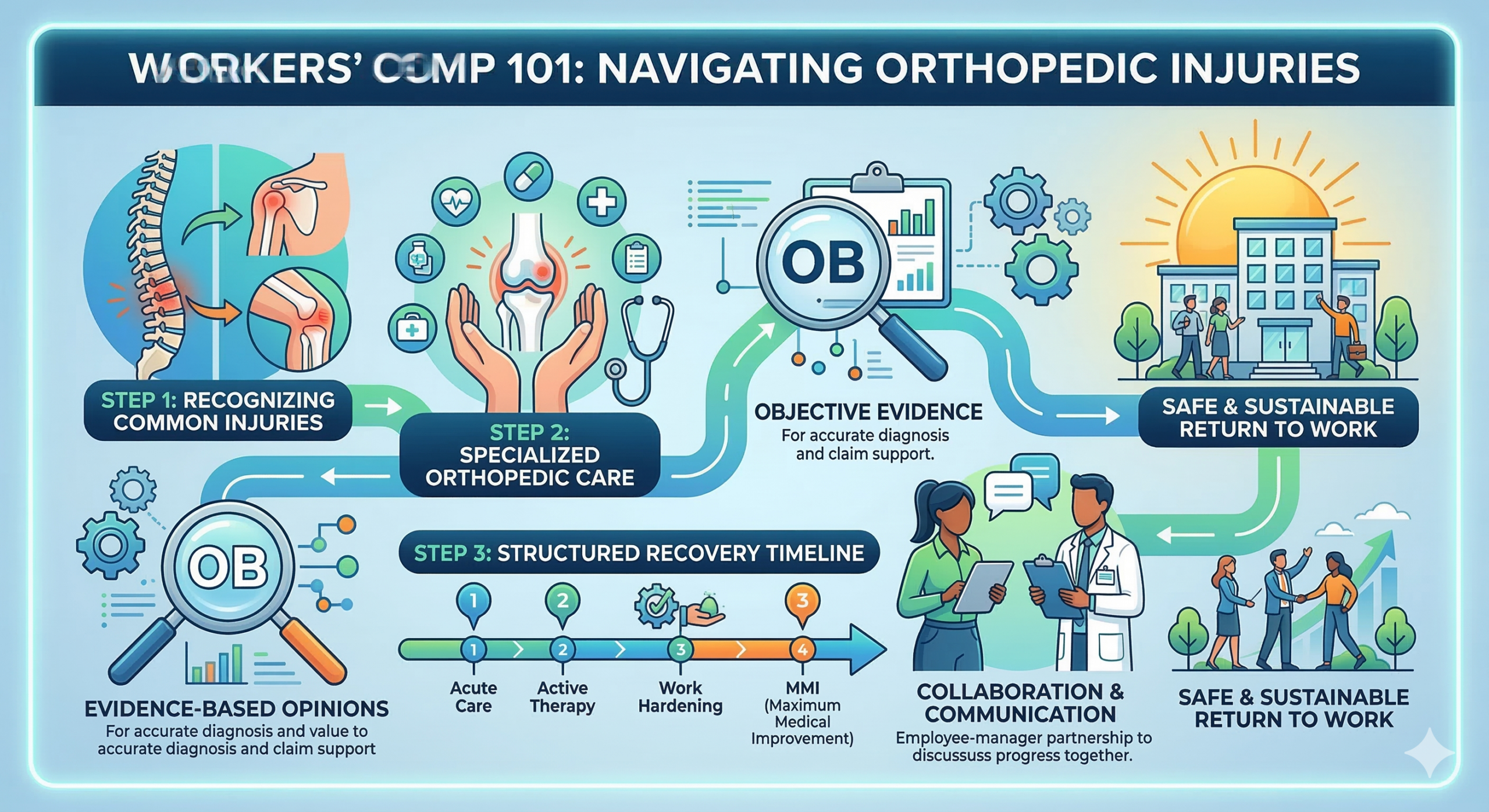
Orthopedic trauma in the workplace rarely happens in a vacuum. It is typically the result of either sudden acute trauma or repetitive strain. The most frequent injuries we see include:
-
Spine and Lower Back Strains: Often caused by improper lifting techniques or heavy manual labor.
-
Rotator Cuff and Shoulder Tears: Common in industries involving overhead reaching or repetitive pushing and pulling.
-
Knee and Ankle Trauma: Resulting from slips, trips, and falls on slick surfaces or uneven construction sites.
The Power of Objective, Evidence-Based Opinions
In the world of workers’ comp injuries, a physician’s “gut feeling” isn’t enough. Case managers and adjusters require objective, evidence-based opinions to move a claim forward. This means:
-
Diagnostic Accuracy: Utilizing advanced imaging (MRI, CT scans, and EMG studies) to pinpoint the exact source of pain.
-
Functional Assessment: Determining what a worker can do, rather than just what they can’t do.
-
Clear Documentation: Providing detailed reports that satisfy the legal requirements of the claim while focusing on the patient’s physical limitations and progress.
Note to Case Managers: Working with a provider who understands the “paperwork” side of a claim reduces friction, prevents delays in treatment, and ensures that all parties are aligned on the medical necessity of procedures.
The Timeline: Returning to Work Safely
The ultimate goal of managing workers’ comp injuries is a safe and sustainable return to work. This isn’t a race; it’s a structured progression:
| Phase | Focus | Goal |
| Acute Care | Pain management and immobilization. | Stabilization of the injury. |
| Active Recovery | Physical therapy and targeted exercises. | Restoring range of motion. |
| Work Hardening | Job-specific functional training. | Building stamina for job demands. |
| MMI (Maximum Medical Improvement) | Final evaluation of recovery status. | Determining permanent or temporary restrictions. |
Why Specialized Care Matters
Navigating a work-related injury is stressful enough without the added burden of a stalled claim. By choosing a provider that specializes in workers’ comp injuries, athletes of the workforce get the specialized orthopedic care they need, while case managers get the objective data required to close the loop.
Recovery isn’t just about healing the bone or the ligament—it’s about restoring a livelihood.