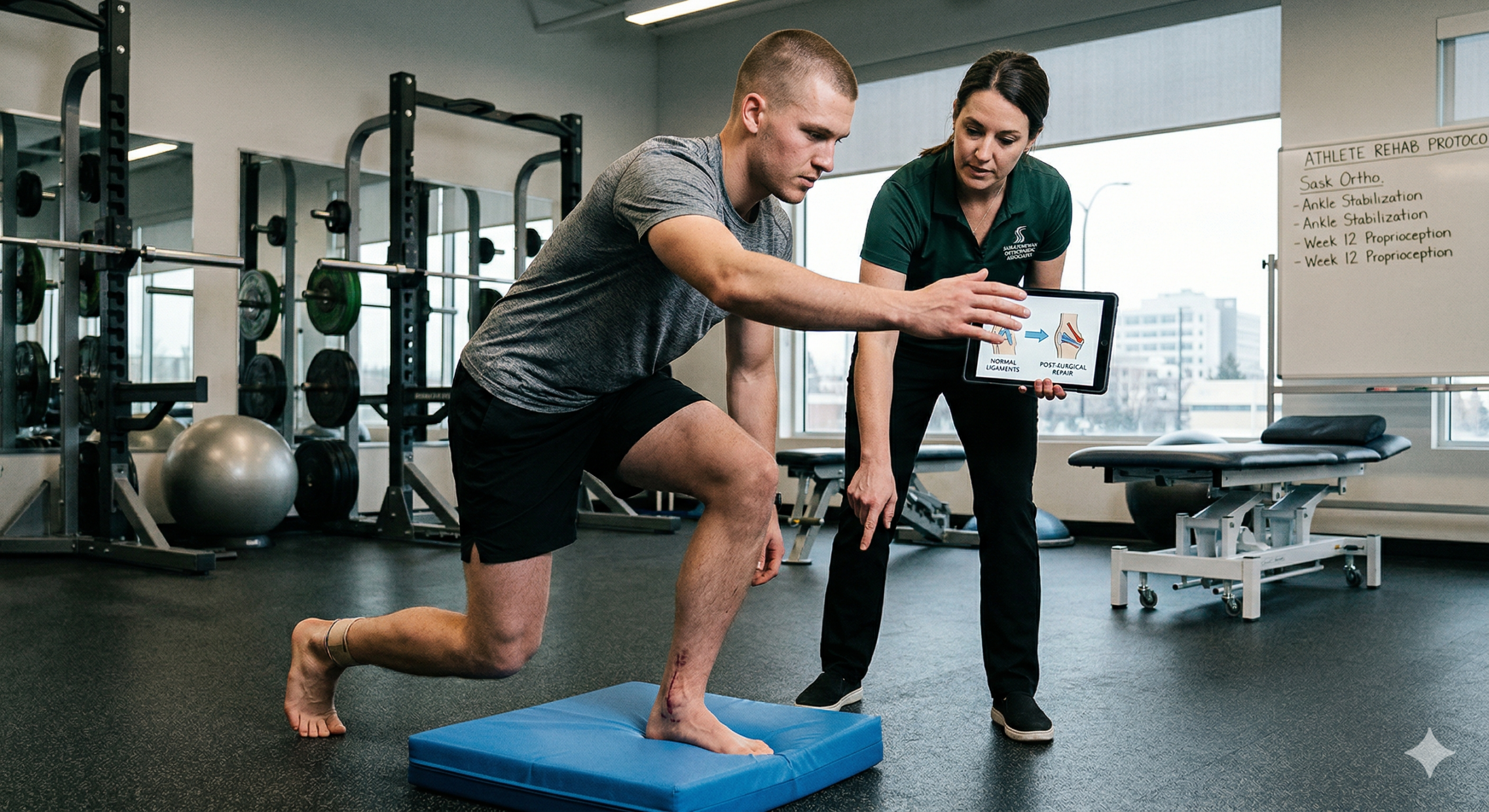
For the dedicated athlete or the weekend warrior, a sprained ankle is often seen as a “right of passage.” You ice it, wrap it, wear a brace for a few weeks, and get back in the game. But what happens when the brace becomes a permanent part of your uniform? What happens when you no longer trust your own body on a transition or an uneven trail?
If you feel like you’ve “tried everything”—from high-end athletic tape to months of physical therapy—yet your ankle still “gives way,” you are likely dealing with Chronic Ankle Instability (CAI).
Signs Your Ligaments Have Quit Their Job
Ligaments are the “seatbelts” of your joints. In a healthy ankle, they provide the mechanical tension needed to keep bones aligned. After repeated injuries, these tissues can become so stretched or scarred that they lose their elasticity—a condition known as mechanical laxity.
You may need to look beyond conservative care if you experience:
-
The “Giving Way” Phenomenon: Your ankle rolls during simple lateral movements or even while walking on flat ground.
-
Persistent Neural Lag: You feel “clumsy” because the nerves in your ankle can no longer tell your brain exactly where your foot is positioned (loss of proprioception).
-
Chronic Tenderness: Lingering pain along the outer edge of the ankle that never truly disappears, even with rest.
The Hidden Risk: Why “Playing Through It” Fails
Many active individuals choose to simply “bolt on” more support via heavy-duty braces. While bracing helps in the short term, it does not fix the underlying structural failure.
Every time your ankle “micro-rolls,” the bones of the joint grind against one another. Over time, this friction wears down the protective cartilage. Left untreated, chronic instability is a fast track to early-onset osteoarthritis, which can permanently limit your mobility and end your athletic career far sooner than expected.
What Does Ankle Stabilization Surgery Actually Entail?
If physical therapy and bracing haven’t restored your confidence, surgery is the gold standard for returning to high-level activity. Modern stabilization (often called a Brostrom-Gould procedure) is designed to restore the “snap” to your ligaments.
-
The Procedure: Through small, minimally invasive incisions, the surgeon identifies the overstretched lateral ligaments. These are tightened and reattached to the bone using tiny, high-strength suture anchors.
-
The Goal: The aim isn’t just to “fix a tear,” but to restore the exact anatomical tension required for the joint to feel “locked in” and secure.
-
The Recovery: While there is a period of protected healing, the long-term results for athletes are excellent. Most patients find they can eventually ditch the brace entirely and return to cutting, jumping, and running with a “new” sense of stability.
Reclaim Your Confidence
You shouldn’t have to plan your life around the “next big twist.” If your ankle is holding you back from the sports and activities you love, it may be time to move past the brace.