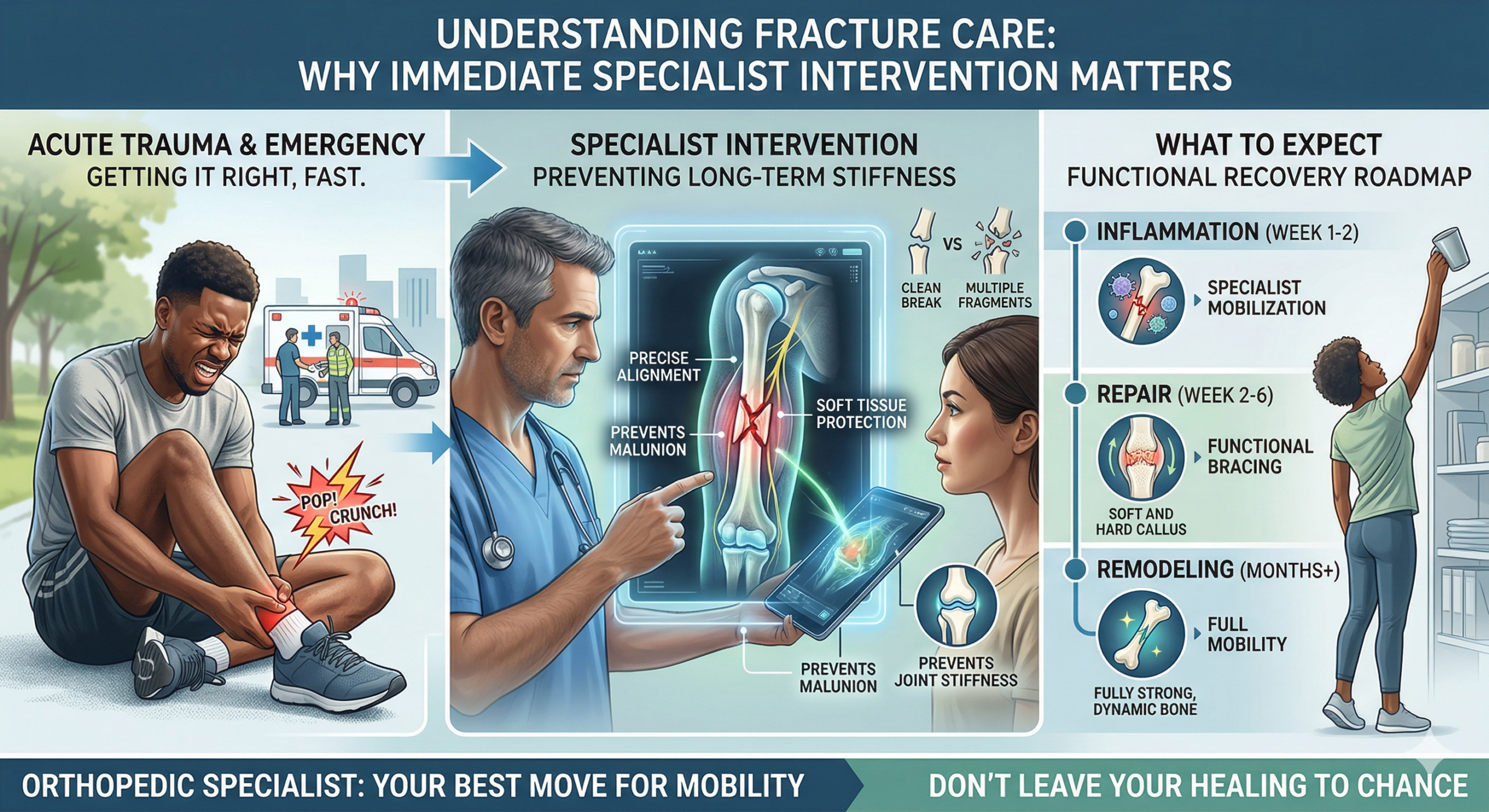
You heard a “pop,” felt a “crunch,” and now there’s a dull ache that definitely wasn’t there five minutes ago. Your first instinct might be to head to the local ER or wait for an appointment with your General Practitioner (GP). While these are great starting points for triage, when it comes to the structural integrity of your body, you really want a specialist behind the wheel.
Here is why seeking immediate specialized fracture care is the best move for your long-term mobility.
The “Simple” Break vs. The Complex Fracture
To the untrained eye, a break is a break. But in the world of orthopedics, the nuance matters.
-
Simple Fractures: These are “clean” breaks where the bone stays in two pieces and remains relatively aligned.
-
Complex Fractures: These involve multiple bone fragments, joints, or skin penetration (compound fractures).
A GP is excellent at diagnosing that a break exists, but an orthopedic specialist understands the mechanics of how that specific break will affect your movement years down the line. We look at the “personality” of the fracture—how it interacts with surrounding tendons, nerves, and blood vessels.
Why Specialists Prevent the “Rusty Hinge” Effect
One of the biggest risks of improper fracture care isn’t just the bone failing to knit; it’s long-term joint stiffness.
If a bone is immobilized for too long—or in the wrong position—the surrounding soft tissues can scar and tighten. Specialists prioritize “functional bracing” and early, safe mobilization. By getting the alignment perfect from day one, we ensure that once the bone is healed, the joint actually works. You don’t just want a healed arm; you want an arm that can still reach the top shelf.
What to Expect: The Roadmap to Recovery
Healing a bone isn’t a “set it and forget it” process. It is a biological marathon that usually follows three main phases:
-
The Inflammation Phase (Week 1-2): This is where the pain and swelling are most intense. Your body is sending a “cleanup crew” to the site.
-
The Repair Phase (Week 2-6): Your body creates a “soft callus” (a bridge of cartilage) that eventually hardens into bone.
-
The Remodeling Phase (Months to Years): The bone is strong enough for use, but your body continues to reshape it to its original strength and contour.
Note: Specialist intervention ensures that during the “Repair Phase,” your bone is held in the exact orientation needed to prevent malunion (healing crooked).
Don’t Leave Your Mobility to Chance
When you experience an acute trauma, time is of the essence. Getting the right eyes on your injury early can be the difference between a full recovery and a lifetime of “weather-predicting” aches.
If you suspect you’ve suffered a break, skip the “wait and see” approach. Seek out emergency orthopedic care to get back on your feet—properly.